Mobile Home Demolition
Cost In California:
What The Cheap Bid Leaves Out.
The unit runs $2,000-$5,000. The pad, the piers, the skirting, the tie-downs and that add-on room nobody permitted are separate · and together they are frequently the bigger half of the invoice.
What’s In This Guide
- What mobile home demolition costs · full line-item table
- Why a mobile home is harder than it looks
- Pre-1978 units: asbestos and lead
- Title, registration and the HCD question
- Park removals vs. private land
- Utilities, and what gets left behind
- Demolish, move or sell?
- A worked example: 720 sq ft single-wide
- Frequently asked questions
What Mobile Home Demolition Costs In California
Mobile home demolition cost in California generally lands between $2,000 and $5,000 for the unit itself · teardown, sorting and haul-off. That is the number most guides stop at. It is also the number that produces angry phone calls, because a manufactured home sits on top of a pile of other work that has to come out with it.
Here are working East Bay ranges, line by line. Your final figure is fixed after a site walk, not before it.
| Line Item | Typical Range | What Moves The Number |
|---|---|---|
| Single-wide teardown & haul-off (600-1,000 sq ft) | $2,000 to $3,500 | Size, access, contents left inside, haul distance |
| Double-wide teardown & haul-off | $3,500 to $5,000 | Debris volume, marriage-wall build, roof type |
| Triple-wide / multi-section | From $5,000 · quoted per section | Section count, site-built roof, permanent foundation |
| Concrete pad, runners & pier footings | $3 to $8 / sq ft | Thickness, rebar, depth, disposal at $90-$160/ton |
| Individual pier pads & small slabs (10×10) | $300 to $800 each | Count, thickness, embedded anchors |
| Skirting, tie-downs & ground anchors | Usually bundled with the unit | Masonry vs. vinyl skirting, anchor depth, soil |
| Deck, porch, carport or add-on room | $2,500 to $6,500 each | Priced as a detached structure · size, slab, roofing |
| Contents & junk left in the unit | $150 to $700 | ¼ load to full load; minimums start at $70-$100 |
| Utility disconnect | $100 to $500 per utility | Electric, gas, water, sewer cap · each its own release |
| Demolition permit & agency fees | $100 to $450+ | Jurisdiction, grading permit, air district notification |
| Asbestos testing | $300 to $900 | Suspect material count, sample count, turnaround |
| Asbestos abatement (if triggered) | $5 to $15 / sq ft | Material type, friability, containment size |
| Lead-safe handling (partial work only) | $3 to $8 / sq ft | Not triggered by a full unit removal |
A documented 720 sq ft unit came in at $4,800 · near the top of the headline range for a small single-wide, because the concrete, the deck, the contents and the permits all landed on the same invoice. Section eight breaks that job down line by line.
Why A Mobile Home Is Harder Than It Looks
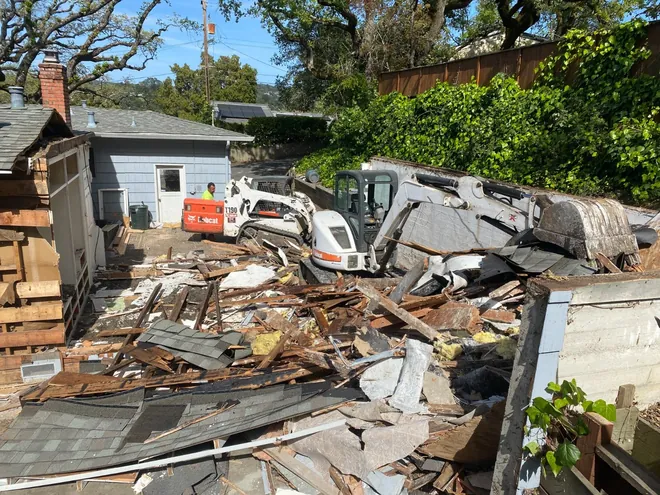
People assume a manufactured home is the cheap job because it’s light. It’s the messiest residential material stream there is, and half the work is below the floor.
- Four waste streams in one building. Steel or aluminum siding and roofing, a wood or steel chassis frame, fiberglass batt insulation and vinyl-clad gypsum panel. Each goes to a different facility and they can’t be mixed if the diversion report has to hold up.
- Appliances and refrigerant. Refrigerators, wall and window AC units, furnaces and water heaters come out and get handled separately, not crushed into the load.
- Tanks. Propane, and on older units fuel oil · located, emptied and removed before anything is cut.
- Tie-downs and anchors. Steel straps and ground anchors driven feet into the soil. Cut them at grade and you leave steel in the ground for the next contractor to hit.
- Piers, footings and runners. Block piers, poured pads, sometimes full concrete runners the length of the unit. That’s concrete removal, priced as concrete removal.
- Skirting. Vinyl, metal, wood or masonry, plus twenty years of whatever got stored behind it.
- Decks, porches, carports and add-on rooms. Site-built, frequently built without a permit, and often the single largest line item on the estimate · a covered addition costs what a detached structure costs.
The metal is the good news: siding, roofing and frame steel recycle cleanly and help you hit California’s minimum 65% diversion of non-hazardous C&D waste, documented with facility receipts. See debris hauling and C&D recycling.
Pre-1978 Units: Asbestos And Lead
Richmond, San Pablo and El Sobrante housing stock is heavily pre-1978, and the older manufactured units parked here are no exception. In that era, asbestos turns up in vinyl floor tile and sheet flooring, the mastic underneath, furnace and duct components, pipe wrap, and some siding and roofing products.
The rule that helps you: no testing is required for material that is entirely wood, glass, rubber or metal · which covers a large share of a mobile home. The rule that costs you: everything else that’s suspect has to be tested if it will be disturbed. Testing runs $300-$900. Abatement, when triggered, runs $5-$15 per square foot, and California requires specific certification for asbestos work involving 100 sq ft or more at a single worksite, plus 24 hours’ notice to the nearest Cal/OSHA enforcement district office.
The federal Lead Renovation, Repair and Painting rule does not apply to demolition of an entire free-standing building · but it does apply to renovation that modifies portions of a pre-1978 structure. Gutting an old unit you intend to keep triggers it. Taking the whole unit out does not.
We test before we quote, so a positive result is a line on your estimate instead of a stop-work order on day two with the excavator on the clock.
Planning A Project In The East Bay?
Free on-site estimate anywhere in Contra Costa or Alameda County. One fixed written number, permits included.
Get My Free EstimateTitle, Registration And The HCD Question
This delays mobile home removals more often than weather does, and it is not something a demolition contractor can solve for you.
A manufactured home is titled and registered through the California Department of Housing and Community Development (HCD). It is not automatically part of the real estate the way a stick-built house is · it is a titled asset, and you are proposing to destroy it. So the owner generally needs to resolve title and any recorded liens before the unit can be demolished or removed.
Requirements and forms change, and we are not going to invent a procedure for you. Locate your title, registration card and the HUD data plate or insignia if the unit has one, then contact HCD to confirm the current process for your situation · expired registration, an estate or previous owner on title, or a lienholder still on record. Start that call the same week you decide to remove the unit. It is routinely the longest lead item on the project.
Park Removals vs. Private Land
Where the unit sits changes the scope more than the unit itself does.
In a park, the park owns the ground. Management sets the access route, work hours, setback from occupied neighboring units and the insurance certificate they want on file before the gate opens · and most parks have a pad turnover standard: the space comes back in a condition they can re-lease, which often means skirting, steps, sheds, decks and sometimes the pad itself all gone, not just the home. That requirement, not your preference, defines the scope, so get it in writing before anyone prices the job. Equipment also has to fit narrow park lanes, and dust and noise control matter far more with homes fifteen feet away.
On private land, you control the site but you own the permit. In unincorporated Contra Costa County that’s the County counter at 30 Muir Road in Martinez, not a city hall · demolition permit, air district notification, PG&E utility release and diversion documentation. Our demolition permit guide walks the package, and this timeline breakdown shows how the weeks stack up.
One rule applies everywhere: any plan to demolish a load-supporting structural member requires Bay Area Air Quality Management District notification regardless of asbestos content, age or size, filed 10 working days ahead · reducible to 72 hours for dwellings of four or fewer units with an added fee.
Utilities, And What Gets Left Behind
Electric, gas, water and sewer each have to be shut off, capped or otherwise controlled at the building or curb line before demolition starts. That’s a Cal/OSHA requirement, not a preference, and disconnects run $100-$500 per utility. Propane and any fuel oil tank get emptied and removed before cutting begins. Caps stay exposed, because the inspector has to see them at the final inspection.
Then there’s the part owners forget until they’re standing on the empty space: the unit leaving does not mean the site is clear. What remains is the concrete pad or runners, the pier footings, the ground anchors, the skirting trench, the utility stubs and risers, and frequently a set of concrete steps and a shed slab.
Whether that matters depends on your plan. Re-leasing the space or parking a newer unit may only need the surface cleaned up. Rebuilding does not · a new foundation, an ADU or anything requiring engineered compaction means the old concrete comes out at $3-$8 per square foot and the ground gets graded to your engineer’s spec. Decide that before you accept a bid; it’s the difference between a $3,000 job and a $7,000 one. See foundation and slab removal and concrete removal.
Demolish, Move Or Sell?
Moving and demolishing are two different trades with two different budgets. In California they even share one contractor classification · C-21, Building Moving/Demolition · which confuses people further.
Relocating a manufactured home whole means it has to survive the trip: a road-legal chassis with axles, tires and a hitch, transport permits, escorts where required, a receiving site that will accept the unit, and a set-up crew on the far end to re-level, re-block, re-anchor and reconnect it. Older units frequently cost more to move than they are worth, and many parks will not accept a home over a certain age · which quietly eliminates most of the buyers you were counting on.
- Soft or rotted floors, sagging roof, water damage
- An older unit no park in range will take
- Add-on rooms permanently tied into the structure
- No buyer lined up, and the lot is needed on a schedule
If any of those are true, moving it is a fantasy that costs you two months. An older single-wide is almost always worth more as recovered metal and a cleared lot than as a resale unit. A newer double-wide in good condition can genuinely be worth moving · and we’ll tell you which one you have at the site walk, even when the answer costs us the job.
A Worked Example: 720 Sq Ft Single-Wide
Private land in unincorporated Contra Costa County. One older single-wide, concrete runners with pier pads, a covered wood deck, a half-load of belongings still inside, two live utilities. Clean asbestos survey.
| Line Item | Cost |
|---|---|
| Single-wide teardown, sorting & haul-off | $2,600 |
| Skirting, tie-downs & ground anchors pulled | Bundled |
| Concrete runners & pier footings (~170 sq ft) | $800 |
| Covered deck & steps | $700 |
| Contents left in the unit (½ load) | $350 |
| Utility disconnect coordination (2 utilities) | $250 |
| Demolition permit & air district notification | $100 |
| Total | $4,800 |
Two things to notice. The unit is only 54% of the bill · the rest is ground work, contents and paper. And this job had a clean survey. Had the vinyl flooring come back positive, abatement across 720 sq ft at $5-$15 per square foot would have added roughly $3,600 to $10,800, more than doubling the project. That single lab result is the widest variable in mobile home demolition cost, which is why testing early is cheap insurance.
Frequently Asked Questions
How much does it cost to demolish a mobile home in California?
Budget $2,000-$5,000 for the unit · roughly $2,000-$3,500 for a single-wide and $3,500-$5,000 for a double-wide, with multi-section units quoted per section from about $5,000. A documented 720 sq ft job totaled $4,800 once the concrete, deck, contents and permits were included. Pads, piers, anchors, skirting, add-ons, utility disconnects, permits and any hazmat are separate line items, and they are why two bids for “the same job” can differ by thousands. Compare scopes, not headline numbers.
Do I need the title to demolish a mobile home?
Plan on resolving it first. A manufactured home is titled and registered through the California Department of Housing and Community Development, so you are destroying a titled asset · and the owner generally needs to clear title and any recorded liens before the unit is demolished or removed. Because requirements change, confirm the current process directly with HCD for your specific situation rather than relying on a contractor’s summary. Start early; it is usually the longest lead item on the whole project.
Is it cheaper to move a mobile home or demolish it?
For older units, demolition is almost always cheaper and far more predictable. Moving one whole requires a road-legal chassis, transport permits, a receiving site and a set-up crew to re-level, re-block, re-anchor and reconnect it · and older homes frequently cost more to move than they are worth, with many parks refusing units over a certain age. Units with soft floors, roof sag or water damage rarely clear that bar at all. Demolition doesn’t care whether the unit is square.
Does the concrete pad come out with the mobile home?
Only if it’s in the scope · and this is the most commonly forgotten cost in the entire project. Pads, runners and pier footings price as concrete removal at roughly $3-$8 per square foot including disposal, with individual small pads at $300-$800 each and dump fees of $90-$160 per ton. If you’re rebuilding, an ADU or a new foundation means it has to come out and the ground has to be graded and compacted. If you’re re-leasing a park space, the park’s turnover standard decides.
How long does mobile home demolition take?
The physical work is one to three days for most units including the pad and piers. The calendar is driven by paperwork: HCD title status, park approval, the demolition permit, utility releases and the air district notification, which requires 10 working days’ notice and can be reduced to 72 hours for dwellings of four or fewer units with an added fee. Plan on a few weeks from signature to cleared lot.
Who removes the propane tank and the appliances?
We do, and they come out before any cutting starts. Propane and any legacy fuel oil tank are located, emptied and removed. Refrigerators, wall and window AC units, furnaces and water heaters are pulled and handled separately rather than crushed into the load, and fluorescent tubes and PCB ballasts are Universal Waste that must be recycled. Anything else left inside is priced as junk removal · $150-$700 depending on volume. See junk removal →

Legacy Demolitions Team
Licensed demolition contractor · CA License #1122603 · El Sobrante, CA
We remove single-wide, double-wide and multi-section manufactured homes from parks and private land across Contra Costa and Alameda County · unit, pad, piers, anchors, skirting and add-ons in one scope, with permits pulled and diversion documented. Prices above are working ranges; your number is fixed after the site walk.
Get The Whole Scope Priced
Send the address, the unit size and a few photos · including one under the skirting if you can get it. We’ll price the unit, the ground under it and everything attached to it, in one fixed number.
Legacy Demolitions LLC · 4533 Appian Way, El Sobrante, CA 94803 · CA License #1122603

Permits pulled, site left clean.
We handle the permit, the utility releases, the teardown and the haul-off, then leave the lot graded and inspection ready. One written price covers all of it.