We Pull The Permits.
You Don’t Chase The County.
The complete East Bay demolition permit reference: the BAAQMD J number, the county checklist, the two pool abandonment tracks, city by city differences, diversion reporting and the Cal/OSHA rules that govern the site. Written by the crew that files these every week.
 We File The Package
The Machine Work Is Days.
The Paperwork Is Weeks.
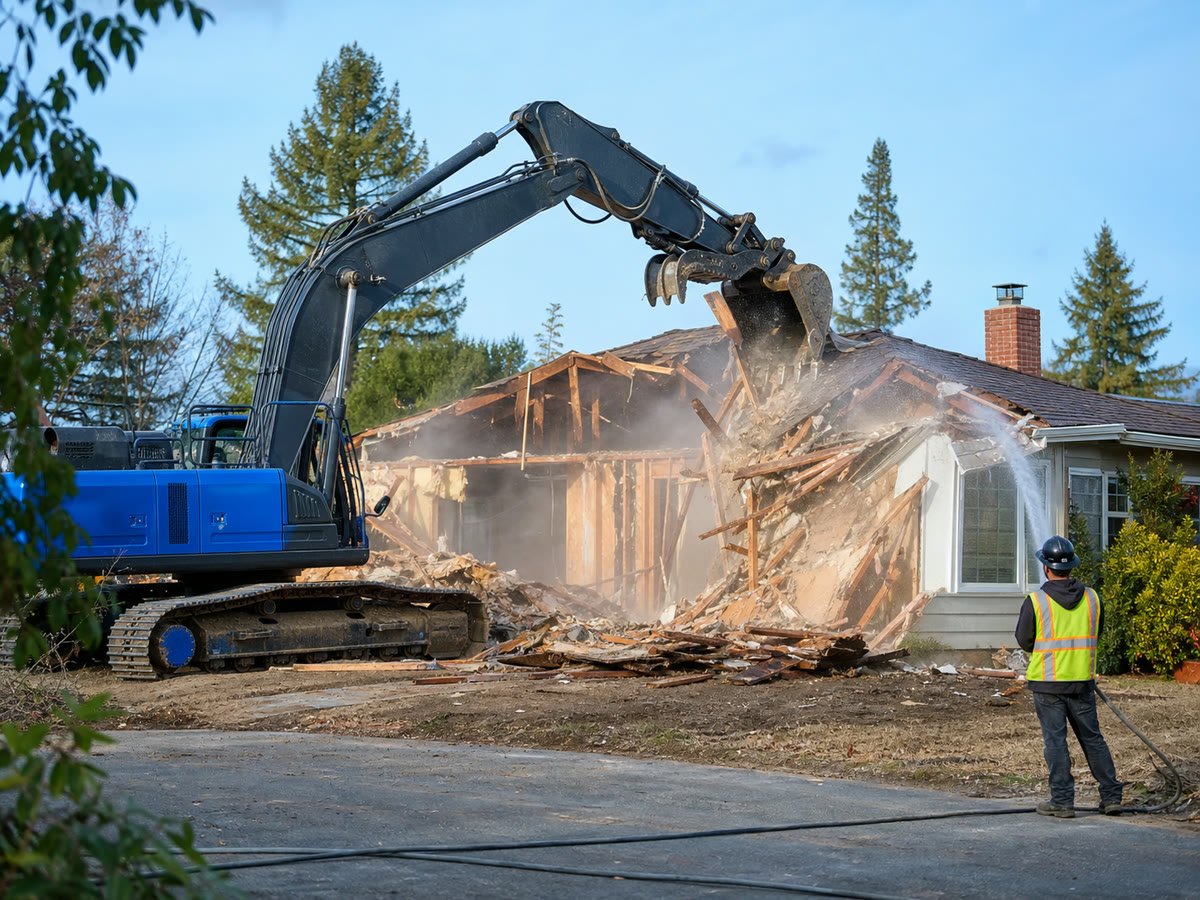
Knocking a house down takes two to five days. Getting legal permission to knock it down takes three to eight weeks. That gap is where almost every East Bay demolition schedule falls apart, not because the demolition is hard, but because five separate agencies each need their own document, in their own order, and two of them will not even open your file until a third one signs off.
A demolition permit is not one permit. It is a package. The building department issues it only after the air district, the utility, the sanitary district, the planning division and sometimes a soils engineer have all put something in the file. Miss one and the counter hands the whole thing back.
We start the permit clock the day you approve the scope, not the day the equipment is free. Everything below is the actual sequence we run on every job.
The Five Approvals Every
East Bay Demolition Needs
Every jurisdiction words these differently. Every jurisdiction requires all five.
The Local Demolition Permit
Issued by the city or county building department with jurisdiction over the parcel. Requires a site plan, proof of ownership or owner authorization, a licensed contractor on record and sign off from planning, the sanitary district and the air district. In unincorporated areas, including El Sobrante, this is Contra Costa County and not a city.
The BAAQMD Asbestos Notification
Filed with the Bay Area Air Quality Management District at least 10 working days before demolition starts, for any demolition of a load supporting structural member regardless of asbestos content, age or size. The J number it generates is what the building department wants to see before releasing your permit.
The Utility Release
Written confirmation from PG&E that electric and gas service is disconnected at the source, plus a water shut off and a sewer cap through the local sanitary district. Cal/OSHA requires every utility shut off, capped or otherwise controlled at the building or curb line before demolition begins. That is law, not best practice.
The Waste Management Plan
Filed before the permit issues, not after. CALGreen sets a statewide minimum of 65% diversion of non hazardous construction and demolition waste. Unincorporated Contra Costa wants the plan up front and a Waste Management Report with weight receipts at closeout, filed through the Green Halo portal since August 4, 2025.
The Final Inspection
One inspection closes the demolition permit. The inspector confirms the structure is gone, the site is safe, the hole is properly backfilled and, this is the one people fail, that the capped utilities are visible. Bury the caps and you get to dig them back up while the inspector waits or reschedules.
Case By Case Add Ons
Grading permits, encroachment permits, tree protection plans, SWPPP and a Notice of Intent for disturbance over one acre, historic review, and Cal/OSHA permits for tall structures and deep excavations. All of them are covered further down this page.
The J Number Is The Long Pole In The Tent
If one item is going to delay your demolition, it is this one.
The notification you file generates a job number, the J number, and that number is what your building department asks for before it releases the demolition permit. The most misunderstood point: notification is required for any plan to demolish a load supporting structural member, regardless of asbestos content, age or size. A 1998 garage with a clean survey still needs one. There is no “too new” exemption and no “too small” exemption on the demolition side.
Renovation is where the thresholds live. For work that is not demolition of structural members, notification kicks in above 100 square feet, 100 linear feet or 35 cubic feet of friable asbestos containing material. That distinction is why an interior strip out and a teardown follow different paths.
Timing: 10 Working Days, Or 72 Hours With A Fee
Working days, not calendar days. A holiday week can quietly add two days to your schedule. For dwellings of four or fewer units the period can drop to 72 hours with an added fee, which is the escape hatch we use when a homeowner needs to move fast on a small structure. It is not available for commercial buildings or larger multifamily.
The start and end dates on the J number are confirmed dates, not an estimated window. If your start date slips and you have not revised the notification by 11:59 PM of the stated start date, you can be in violation even though you have not touched the building. Weather, a late utility release, a subcontractor no show: none of it excuses the paperwork.
We revise the notification the moment a date moves, and we build float into the dates we file in the first place.
The Survey Exemption Everyone Misreads
Residential buildings of four or fewer dwelling units do not require a certified asbestos survey before demolition. That is the exemption, and it is where people stop reading. Even under it, suspect materials must still be tested if they will be disturbed: HVAC ducting and systems, acoustic ceiling material and acoustic plaster. Most of the pre 1978 housing stock in Richmond, San Pablo and El Sobrante still gets sampled, because nearly all of it has at least one of those three.
There is a genuine no testing case: material that is entirely wood, glass, rubber or metal. A wood frame carport with a metal roof and no ducting, acoustic ceiling or plaster is a clean skip. That category is narrower than most people expect, and calling it wrong is expensive.
BAAQMD Fee Schedule
| Notification type | Fee | Notes |
|---|---|---|
| Demolition, single family dwelling | $90 | Structural demolition of an SFD |
| Demolition, all other | $372 | Commercial, industrial, multifamily above four units |
| Late notice, under 10 days | +$619 | Added on top of the base demolition fee |
| Asbestos at an SFD, 100 to 500 sq ft | $185 | Billed by area of asbestos containing material |
| Asbestos at an SFD, 501 to 1,000 sq ft | $679 | |
| Asbestos at an SFD, 1,001 to 2,000 sq ft | $988 | |
| Asbestos at an SFD, over 2,000 sq ft | $1,358 |
Fee schedule effective 7/1/2026. BAAQMD notification questions: 415-749-4762. Confirm current amounts with the district, fee schedules are revised periodically.
A clean single family teardown carries a $90 air district line. The same house with 1,200 sq ft of asbestos containing material carries $90 plus $988, before a dollar of abatement labor. A late filing turns a $90 line into $709. That is why we file early and file accurately: the cheapest permit strategy is the one that never needs a correction.
Unincorporated Contra Costa County
If your property is in El Sobrante, it is here. There is no City of El Sobrante.
The County permits it, the County inspects it, and the County checklist is the one that governs your job.
- Site plan showing the structure, property lines, adjacent structures and access.
- SWPPP and Notice of Intent if the project disturbs more than one acre of soil.
- Tree protection plan where protected trees are within the work area.
- Planning Division approval, obtained before the building permit application is submitted.
- Sanitary District approval for the sewer cap.
- BAAQMD approval, your J number under Regulation 11, Rule 2.
- PG&E utility release confirming electric and gas disconnection (800-743-5000).
- PCB Screen Assessment Form, a required screening for polychlorinated biphenyls.
- Waste Management Plan showing a minimum 65% recycling or salvage.
- Universal waste handling for fluorescent tubes and PCB containing ballasts.
30 Muir Road, Martinez, CA 94553
Phone: 925-655-2700
Online permits: epermits.cccounty.us
Much of the process runs through the county ePermits portal, but the package still involves third party sign offs that have to arrive in the right order. Planning Division approval is a hard gate: submit the building permit application without it and nothing moves.
The PCB Screen Assessment Form is a real submittal item, not a formality. Older fluorescent light ballasts, certain caulks and some electrical equipment are the usual sources. Tubes and PCB ballasts must be handled as Universal Waste and recycled. Throwing them in the debris box is a disposal violation, and the receiving facility will flag it.
On the final inspection the inspector confirms the structure is fully removed, the excavation is properly backfilled, the site drains and the capped utilities are visible. We leave the caps exposed and flagged. Every crew that backfills over them ends up hand digging in front of an inspector, and the reinspection costs a day.
Two Permit Tracks.
One Of Them Marks Your Parcel.
The difference is not cost or convenience. It is whether you can ever build on that ground again.
Abandon a pool under the uncertified fill track and the County places a note on the parcel reading “Restricted Area on Site, due to abandoned swimming pool not Suitable for Building.” That note follows the property. It shows up in title work, it shows up when a buyer’s inspector pulls county records, and it is the first thing an ADU designer runs into. Saving a few thousand now can cost you a buildable corner of your lot forever.
Track I · Engineered Fill
The full removal path. The shell is broken out, the hole is backfilled with engineered fill and the compaction is certified, so the ground is treated as buildable.
- Compaction to a minimum 90% relative compaction, tested per ASTM D1557.
- Testing performed by an accredited soils firm.
- Final compaction report signed by a licensed civil or geotechnical engineer.
- Submittal includes a 24 by 36 inch site plan plus the geotechnical report.
- The applicant must disclose the source of the imported dirt.
- No restriction note is placed on the parcel.
Choose this if you are planning an ADU, an addition, a future structure or a sale in the next decade.
Track II · Uncertified Fill
The partial path. The shell stays in the ground, holes are punched through it for drainage and the area is backfilled without certified compaction. Landscaping only.
- The parcel receives the restriction note quoted above.
- Not allowed where the ground slopes steeper than 10%.
- Minimum three drainage holes, at least 24 inches across, no more than 8 ft apart, one in the deepest section.
- Top 24 inches of the bond beam removed unless it stays above finish grade.
- No concrete or debris under 6 inches may go into the drainage holes.
- Backfilled area is for landscaping only. Not buildable.
Choose this only if the pool sits in a flat back corner you will never build on.
The County Inspection Sequence
Track I runs through three grading inspections in a fixed order. Miss the middle one and you can be asked to re excavate to prove the fill underneath.
| Inspection | Code | When it happens |
|---|---|---|
| Rough grade | #601 | After the shell is broken out and the hole is prepped, before fill goes in |
| In progress | #608 | When the fill reaches 48 inches from finish grade, the compaction checkpoint |
| Grading and drainage final | #620 | At completion, with the signed compaction report in hand |
The #608 in progress inspection is the one that trips people. It is a mandatory hold point at a specific elevation, not a courtesy call. Run past 48 inches from finish grade without calling it and the inspector has every right to make you pull material back out. Full pricing for both tracks is on our pool removal page.
Four Jurisdictions.
Four Different Answers.
A package that sails through the County counter gets rejected in Richmond, and Oakland will not issue the permit until a recycling plan is approved first.
| Jurisdiction | Notable extra requirements | Diversion | Watch out for |
|---|---|---|---|
| Unincorporated Contra Costa (incl. El Sobrante) | PCB Screen Assessment Form · Planning Division approval before submittal · sanitary district approval · universal waste handling | 65% min | One final inspection, capped utilities must be visible |
| Richmond | Separate sewer cap permit · DPR 523a for structures over 50 years old · BAAQMD no asbestos certification · Pest Control Clearance Certification · PG&E disconnect form | State minimum | Pest clearance is Richmond specific and surprises out of town contractors |
| Concord | Grading and encroachment permits · refundable recycling deposit · pool water neutralized before sanitary sewer discharge | 50% waste 75% inerts | Five day clear weather forecast required, permits expire 180 days after the last passed inspection |
| Oakland | Waste Reduction and Recycling Plan approved before permit issuance · Green Halo documentation · PCB screening for non single family · approved hauler list | Per approved WRRP | Trigger is demolition of more than half the exterior walls, plus soft demo of commercial interiors |
Richmond: pest clearance and a 50 year clock
Richmond wants a demolition permit and a separate sewer cap permit, two applications rather than one. Structures over 50 years old that are not already on the Richmond Register need a completed DPR 523a so the Planning Director can evaluate historic significance. Given the local housing stock, most single family teardowns land in that bucket. The counter is at 450 Civic Center Plaza, Monday to Friday, 8:30 to 4:00.
Concord: weather windows and water chemistry
Concord layers grading and encroachment permits on top and sets its own targets, backed by a refundable recycling deposit collected at issuance. Pool water must be neutralized before discharge to the sanitary sewer and never to a storm drain (Central Contra Costa Sanitary District, 925-229-7288). Demolition needs a five day clear weather forecast, the bond beam comes down at least 12 inches below grade and backfill goes in 8 inch lifts at 90% relative compaction.
Oakland: recycling plan first, permit second
An approved Waste Reduction and Recycling Plan is required before the permit issues, documented through Green Halo. You cannot file it after you start. Oakland also requires PCB screening for non single family structures and keeps an approved hauler list. Use a hauler that is not on it and your diversion documentation can be invalidated even if the material genuinely got recycled.
Everywhere else in the East Bay
San Pablo, Pinole, Hercules, El Cerrito, Berkeley, Albany, Orinda, Lafayette, Moraga, Walnut Creek, Martinez, Pleasant Hill, Concord, Alameda and San Leandro each run their own counter. We file in all of them. Tell us the address and we will tell you which requirements apply before you commit to a schedule.
65% Is Not A Goal.
It Is A Permit Condition.
CALGreen sets a statewide minimum of 65% diversion of non hazardous construction and demolition waste. Failing it does not get you a warning, it holds your final inspection.
In unincorporated Contra Costa the requirement runs in two halves. A Waste Management Plan goes in before the permit issues, projecting what comes off the site and where it goes. A Waste Management Report comes in after completion, with receipts proving it happened.
The receipts are specific. Each has to show the facility name, the date, the place of origin, the material type and the quantity. A generic dump ticket with a weight and nothing else does not close a file. This is the most common reason a demolition permit sits open for weeks after the site is already bare dirt.
All plans and reports go through the Green Halo portal. Paper submittals are done. If a contractor still promises to drop the tickets off at the counter, they have not filed a Contra Costa demolition since 2025.
One useful exclusion: excavated soil and land clearing debris are not counted in the calculation. That matters where dirt volume dwarfs the structure, like a hillside teardown in El Sobrante or Orinda.
RecycleSmart administers C&D recycling for Danville, Moraga, Lafayette, Orinda, Walnut Creek and unincorporated Contra Costa. In those jurisdictions debris must move via a Registered C&D Transporter to an Approved C&D Processing Facility. Registration costs $370 per year. If your hauler is not registered, the tonnage may not count toward your diversion requirement no matter where it actually went.
When You Also Need A Grading Permit
Demolition and grading are separate permits. On most teardowns you need both.
| Condition | Contra Costa threshold | What it means on a job |
|---|---|---|
| Excavation depth | Over 5 ft | Basement removal, deep footings, pool shells |
| Excavation volume | Over 200 cy | Reached faster than expected, a 2,000 sq ft house yields roughly 240 cy of debris alone |
| Fill supporting a structure | Any amount | Engineered fill for a future foundation or ADU pad |
| Fill depth | Over 3 ft | Backfilling a pool or a basement |
| Fill volume | Over 200 cy | Import for pad building or site leveling |
| Lafayette, Moraga, Orinda | 50 cy | A quarter of the county threshold, small jobs trigger permits |
| Neighbor notification | 1,000 cy+ | Adjacent property owners are notified before work starts |
A grading permit application in Contra Costa requires three sets of plans stamped by a licensed California civil engineer or architect, plus two copies of a geotechnical report. That is a design cost and a schedule item. Engineered plans are not a same week turnaround and need to be in motion long before the demolition permit is ready.
The practical takeaway for an ADU project: if you are removing a pool or a slab and then building on that footprint, you are almost certainly in grading permit territory. Budget the engineer and the soils report alongside the demolition. See grading and leveling.
The Rules That Govern The Site Itself
Building permits control whether you may demolish. These control how.
Cal/OSHA permits · 8 CCR §341
A Cal/OSHA permit is required to demolish any building or structure more than 36 feet in height, and for trenches or excavations 5 feet or deeper that a person enters. This is separate from and additional to your building department permit. Thirty six feet catches more buildings than people expect: a tall two story with a steep roof, most three story structures and most commercial shells.
Pre demolition duties · 8 CCR §1735
Utilities must be shut off, capped or otherwise controlled at the building or curb line. The site must be checked for hazardous chemicals, gases, explosives and flammables. Pipe insulation, steel fireproofing and HVAC ductwork must be surveyed for asbestos, those three are named in the regulation because they are where it hides in older buildings.
811 / USA North · Gov. Code §4216.2
Before any excavation the excavator must notify the regional notification center at least 2 working days and not more than 14 calendar days in advance. Call too early and the ticket ages out, call too late and you are excavating illegally. A ticket is valid for 28 days, so on a long demolition and grading sequence that clock runs out mid project and the ticket has to be refreshed.
Asbestos registration
Any employer doing asbestos work involving 100 sq ft or more at a single worksite must register with Cal/OSHA and give 24 hours notice to the nearest enforcement district office. That is separate from the BAAQMD notification and neither one substitutes for the other.
What To Check Before You Hire Anyone
California licenses demolition specifically. The classifications that matter are C-21 for building moving and demolition, C-22 for asbestos abatement (required for asbestos work of 100 sq ft or more), and Class A or Class B, commonly carried alongside C-21 for pool removal work.
- The license number is active and in the right classification.
- Workers’ compensation coverage is current.
- The general liability certificate is real and names you.
- The permit responsibilities are in writing.
Who files the BAAQMD notification, who pulls the demolition permit and who submits the diversion report? If the answer is “you do, as owner,” you are not hiring a demolition contractor. You are hiring equipment and an operator, and you have taken on five agencies worth of liability.
Legacy Demolition holds CA License #1122603. We file the notification, pull the permit, coordinate the utility releases and submit the diversion report on every job we run.
Permit Questions We Get Weekly
How long does the permit package actually take?
Three to eight weeks in most East Bay jurisdictions, driven by the BAAQMD 10 working day notice and by how fast planning and the sanitary district respond. We start the clock the day you approve the scope, so the paperwork runs while the schedule is being set rather than after.
My house is from the 1990s. Do I still need a J number?
Yes. Notification is required for any demolition of a load supporting structural member regardless of asbestos content, age or size. There is no “too new” exemption on the demolition side.
Can I skip the asbestos survey on a single family home?
You can skip the certified survey on buildings of four or fewer dwelling units, but suspect materials still have to be tested if they will be disturbed: HVAC ducting, acoustic ceiling and acoustic plaster. Only an all wood, glass, rubber or metal structure is a genuine no testing case.
Which pool abandonment permit should I choose?
If there is any chance of building on or near that footprint, or of selling within the decade, take the engineered fill track. The uncertified track puts a permanent “not suitable for building” note on the parcel that follows the property through title.
Who is responsible if the permit is wrong?
Whoever is on record. That is why we pull the permit in our name, with our license, and file the notification and the diversion report ourselves. If a contractor asks you to pull the permit as owner, the liability is yours.
Do you handle jurisdictions outside Contra Costa?
Yes. We file in Alameda County jurisdictions including Oakland, Berkeley, Albany, Alameda and San Leandro, plus every Contra Costa city we serve. Requirements differ by counter and we confirm them before quoting a schedule.
Everything on this page is general information compiled from public agency requirements and our own filing experience in the East Bay. Requirements, fees and portals change. Confirm current rules with the agency that has jurisdiction over your parcel, or ask us and we will confirm them for you.
Permits Pulled Across The East Bay
Five agencies. One point of contact.
We file the BAAQMD notification, pull the demolition permit, coordinate the utility releases and submit the diversion report. You approve the scope and we handle the counters.