How Long Does It Take
To Demolish A House?
Days On Site. Weeks On Paper.
The machine work on a Bay Area house is two to five days. Everything before it · survey, permit, air district notice, utility release · is where the calendar actually goes. Here is the whole timeline, week by week.
What’s In This Guide
The Short Answer, And The Number Nobody Tells You
Ask how long it takes to demolish a house and almost every answer online gives you the same number: two to five days. That number is correct and close to useless, because it only describes the part where the excavator is running. On a typical East Bay teardown the machine work is 2-5 days and the process around it is 4-8 weeks.
That is the whole insight. Demolition is a paperwork problem with a construction event at the end. The house comes down in under a week. Getting legal permission for that week takes a month or more, and almost none of it can be rushed with money.
2-5 days of demolition. 1 day of grading. 4-8 weeks of survey, permit, notification and utility release before either one can start. If a contractor tells you “about a week” and does not mention the permit clock, they are answering a different question than the one you asked.
The Full Timeline, Week By Week
From first phone call to bare graded dirt: every stage, roughly when it lands, and what most often stalls it. Treat the week numbers as a planning frame, not a promise · several stages are controlled by agencies and utilities, not by your contractor.
| Stage | Typical Timing | How Long | What Stalls It |
|---|---|---|---|
| Site walk & written estimate | Week 0 | 1-4 days | Scheduling access; locked or occupied structure |
| Asbestos survey & sampling | Week 1 | Half a day on site | Finding suspect materials behind finishes |
| Lab turnaround on samples | Week 1-2 | 2-7 business days | Rush vs. standard queue; number of samples |
| Permit package prepared & submitted | Week 1-2 | 2-5 days to assemble | Owner signature, site plan, PCB screen form |
| Planning Division approval | Week 2-4 | 1-4 weeks | Historic review, tree protection plan, corrections |
| Sanitary district approval | Week 2-4 | Days to weeks | Sewer cap detail, district workload |
| BAAQMD notification (J number) | Week 2-3 | 10 working days’ notice | Cannot start earlier; 72-hour option costs extra |
| PG&E electric & gas release | Week 2-5 | Utility-controlled | PG&E crew scheduling · the classic wildcard |
| Asbestos abatement (if triggered) | Week 4-6 | 1-5 days on site | Cal/OSHA registration and 24-hour notice; containment size |
| USA North 811 ticket | Before digging | 2 working days’ minimum | Must be no more than 14 calendar days ahead; valid 28 days |
| Demolition on site | Week 5-7 | 2-5 days | Debris volume, access, weather, foundation type |
| Foundation / slab removal | Same mobilization | 1-2 days | Thickness, rebar, basement or crawl space |
| Grading & compaction | Week 6-7 | 1-2 days | Engineer’s compaction spec and test schedule |
| Final inspection | Week 6-8 | 1 visit | Inspector availability; capped utilities must be visible |
| Closeout paperwork & diversion report | Week 7-8 | 3-10 days | Facility receipts, Green Halo portal entry |
The survey, the permit review and the air district notice can overlap. A crew that submits everything the same week compresses a nine-week job into six. A crew that runs them one after another turns six weeks into eleven. Same house, same price, very different calendar.
Unincorporated Contra Costa County wants a site plan, Planning Division approval before the building permit is submitted, sanitary district approval, air district approval, a PG&E utility release and a PCB Screen Assessment Form · plus a waste management plan filed before the permit issues. Every one of those is a separate desk. We break the package down in our Contra Costa County demolition permit guide.
What Happens On Site, Day By Day
Once the paperwork clears, the physical work is fast and runs in a fixed order. This is a typical 1,200-1,800 sq ft single-story house, flat lot, normal street access.
| Day | What Happens | What Exists At The End Of It |
|---|---|---|
| Day 1 · AM | Mobilize equipment, set fencing, protect storm drains, stage the water truck for dust suppression, verify every utility cap is off and visible, confirm the dig ticket is live | A controlled, signed, protected site |
| Day 1 · PM | Soft strip: appliances, fluorescent tubes and PCB ballasts pulled as universal waste, salvage and metal separated, anything recyclable staged before it gets crushed | Hazard items out, diversion started |
| Day 2 | Structure comes down · roof, then walls, then framing · pulled in toward the center of the pad with the excavator, water running the whole time | House is a sorted pile, not a building |
| Day 3 | Separate and load: wood, metal, gypsum and inert material into their own trucks; first haul cycles to the approved processing facility | Pile shrinking, weight tickets accumulating |
| Day 4 | Foundation, footings, stem walls and slab broken out and loaded; crawl space or basement backfilled if that’s the scope | Below-grade concrete gone |
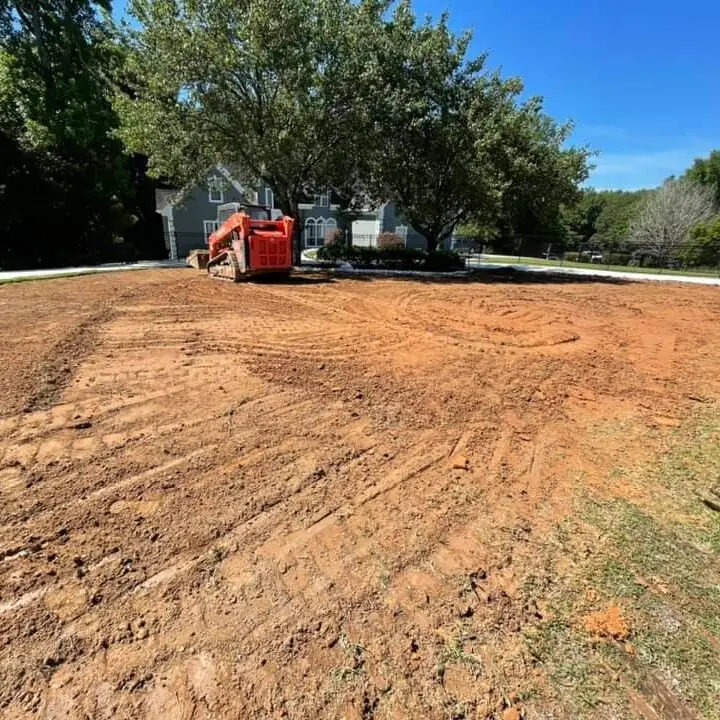
| Day 5 | Final load-out, rough grade, compaction to the engineer’s spec, site swept, photos taken, final inspection called | Bare graded dirt, caps exposed |
Two-story homes, hillside lots and basements push this to seven or eight days. A detached garage or small cottage compresses it to one or two · see our garage demolition cost guide.
The BAAQMD Confirmed-Dates Trap
This is the most misunderstood part of a demolition schedule, and it is why your contractor gets tense when you ask to “push it a week.”
Any plan to demolish a load-supporting structural member of a building requires notification to the Bay Area Air Quality Management District under Regulation 11, Rule 2 · regardless of asbestos content, age or size. Wood house, metal shed, brand-new construction: it still applies. The notification gets you a J number, and it must be filed 10 working days before work starts. For dwellings of four or fewer units that can be reduced to 72 hours with an added fee.
The start and end dates you put on that notification are confirmed dates, not an estimated window. If the job is going to start on a different day than the one you filed, the notification has to be revised · and failing to revise it by 11:59 PM of the stated start date can be a violation. That is why a demolition date is not a flexible date. It is a date filed with a regulatory agency.
So once the J number is filed, moving the demolition because your architect wants another walkthrough is not a phone call · it is an amended regulatory filing with a deadline attached. Decide the date, then hold it.
Fees run $90 for a single-family dwelling demolition and $372 for all other demolition, with a late notice adding $619. Asbestos operations at a single-family dwelling are billed by area, from $185 for 100-500 sq ft up to $1,358 above 2,000 sq ft. The air district’s asbestos line is 415-749-4762.
Planning A Project In The East Bay?
Free on-site estimate anywhere in Contra Costa or Alameda County. One fixed written number, permits included.
Get My Free Estimate240 Cubic Yards: Why Debris Volume Sets The Day Count
People assume the house coming down is the slow part. It isn’t. Knocking a wood-framed house over is a few hours of machine time. Hauling it away is the job. Debris volume, not structure size, is what sets your day count.
A 2,000 sq ft house produces roughly 240 cubic yards of debris. That is not a dumpster. That is a convoy.
Depending on whether you’re loading 20-yard roll-offs, 30-yard boxes or end-dump trailers, 240 cubic yards of mixed debris is six to twelve full loads · and concrete moves separately in heavier, smaller loads, because inert material is hauled by weight rather than volume. Each load is a round trip to an approved processing facility, and in the East Bay that round trip is rarely under an hour.
Two things follow. Your day count is really a truck-cycle count · a tight lot that fits one truck at a time takes longer than an open lot where two can stage. And sorting is not optional: California requires a minimum 65% diversion of non-hazardous C&D waste, unincorporated Contra Costa requires a waste management plan before the permit issues and a report with receipts after, and as of August 4, 2025 both go through the Green Halo portal. See debris hauling and C&D recycling.
What Makes It Faster
You have more control over the calendar than you think · but every lever is at the front of the project, not the back.
- Send photos up front. All four exterior sides, the electrical panel, the water heater and furnace, under the house if there’s a crawl space, and any flooring you suspect is old vinyl tile. We pre-scope from those instead of coming back twice.
- Sign quickly. The permit application needs the owner’s signature. Every day it sits in your inbox is a day Planning review hasn’t started · the most common self-inflicted delay we see.
- No asbestos. A structure that is entirely wood, glass, rubber and metal needs no testing at all, and a clean lab result pulls abatement, Cal/OSHA registration and the 24-hour enforcement notice off the critical path. That alone is two to three weeks.
- Clear, flat access. If a truck and an excavator both reach the structure without matting a lawn or working around a neighbor’s fence, the on-site portion shrinks by a day or two.
- An unincorporated parcel. El Sobrante and much of the surrounding area is unincorporated County, so the submittal goes to 30 Muir Road in Martinez rather than through a city’s extra layer of review. One counter, one process. See our El Sobrante service area page.
- A vacant structure. No tenant coordination, no move-out date, no belongings to work around, no live utilities someone still needs.
What Makes It Slower
And here is the other list. Any one of these turns a six-week project into a ten-week project.
- Historic review. In Richmond, a structure over 50 years old that is not on the Richmond Register requires a completed DPR 523a form for Planning Director evaluation before demolition is approved. Richmond also wants BAAQMD certification that no asbestos is present, a pest control clearance certification from a state-licensed exterminator, and a Demolition, Utility Disconnect form signed by PG&E. Historic review fees alone run $300 to $10,000. Details in our Richmond demolition permit guide.
- A positive asbestos result. Abatement adds $5-$15 per square foot, a licensed and registered abatement contractor, Cal/OSHA registration for work of 100 sq ft or more, 24 hours’ notice to the nearest enforcement district office, and one to five days of containment work before demolition can start.
- A hillside lot. Access is the biggest swing factor in East Bay demolition, on price and schedule. Hillside work also drags in a grading permit · required for excavation deeper than 5 feet or over 200 cubic yards, with plans stamped by a licensed civil engineer or architect plus a geotechnical report. Grading of 1,000 cubic yards or more triggers neighbor notification.
- An occupied neighbor dispute. Shared fences, encroaching structures, a driveway easement, an objection during the comment window. None of these stop a legal demolition; all of them eat weeks.
- Rain. Wet weather turns the site into a runoff problem, and jobs disturbing more than an acre need a SWPPP and Notice of Intent. Some jurisdictions go further · Concord won’t allow pool demolition without a five-day clear-weather forecast. A rain delay is also exactly when the confirmed-dates problem above bites.
- A rejected permit package. A missing PCB screen form, an unsigned utility release, a site plan without dimensions · any one sends it back, and you rejoin the queue at the end rather than where you left off.
- PG&E scheduling. Gas and electric release is utility-controlled and the item we can least influence. Cal/OSHA requires every utility shut off, capped or otherwise controlled at the building or curb line before demolition starts, so there is no working around it. Start it the same week the permit is submitted; PG&E is 800-743-5000.
What To Actually Plan For
Here is how we tell homeowners to block out the calendar. These are planning ranges built from how these jurisdictions actually behave, not guarantees · your written schedule comes with your fixed estimate after the site walk.
| Scenario | Signature To Bare Dirt | Days On Site |
|---|---|---|
| Detached garage or small outbuilding, unincorporated County | 3-5 weeks | 1-2 days |
| Single-story house, flat lot, clean asbestos survey | 4-6 weeks | 2-4 days |
| Two-story house, flat lot, clean survey | 5-7 weeks | 4-6 days |
| Any house with asbestos abatement triggered | 6-9 weeks | 4-8 days |
| Richmond structure over 50 years old requiring DPR 523a | 8-12+ weeks | 3-6 days |
| Hillside lot with a grading permit and geotechnical report | 8-14 weeks | 5-10 days |
Three rules come out of that table. Start the permit clock the day you decide, not the day your architect finishes drawings · demolition approval does not depend on your new plans. Test early: a positive asbestos result at week five costs three weeks, the same result at week one costs almost nothing. And don’t book the rebuild crew off the demolition date · book them off the final inspection, which is the milestone that actually releases the lot.
For budget alongside the schedule, our Bay Area demolition cost guide has the current working ranges, and the residential demolition service page covers everything included in a full teardown scope.
Frequently Asked Questions
How long does it take to demolish a house?
The demolition itself takes two to five days for a typical single-family home, plus a day of grading. The full project · site walk, asbestos survey, permit approvals, air district notification, PG&E release, demolition, grading, final inspection and closeout · runs four to eight weeks in the East Bay. Add two to three weeks if abatement is triggered, and more for a structure over 50 years old in a city with historic review.
How long does a demolition permit take in Contra Costa County?
Plan on two to four weeks once it is submitted complete. It is not a single approval · you need a site plan, Planning Division approval before the building permit submittal, sanitary district approval, BAAQMD approval, a PG&E utility release, a PCB Screen Assessment Form and a waste management plan filed before the permit issues. A package that comes back for corrections restarts the queue, so assembling it properly beats filing it fast.
Can a house be demolished in one day?
Knocking a small wood-framed house down can take a few hours. Getting the debris off the lot cannot. A 2,000 sq ft house makes roughly 240 cubic yards of debris · six to twelve truckloads plus separate loads for concrete. Add foundation removal and grading and one day is unrealistic for anything bigger than a shed. Small detached garages and cottages genuinely do finish in a day.
What is the BAAQMD 10 working day notice, and can it be shortened?
Any demolition of a load-supporting structural member requires notification to the Bay Area Air Quality Management District at least 10 working days before work starts, regardless of asbestos content, age or size. For dwellings of four or fewer units it can be reduced to 72 hours with an added fee. The start and end dates on that notification are confirmed dates, not an estimated window · if the schedule moves, it has to be revised by 11:59 PM of the stated start date or it can be a violation.
Does rain stop a demolition?
Often, yes. Wet weather makes dust control moot but turns the site into a mud and runoff problem, and storm drain and erosion control obligations get serious fast. Jobs disturbing more than an acre require a SWPPP and Notice of Intent. A rain delay is manageable · but it has to be handled as a revision to the air district notification, not an informal slip, or you pick up a violation on top of the lost day.
How soon after demolition can I start building?
You need the final inspection signed off, and at that inspection the capped utilities have to be visible · so don’t bury them. You also need the waste management report with facility receipts submitted through the Green Halo portal to close out the permit. Most homeowners are cleared to start foundation work within one to two weeks of the last truck leaving, assuming grading and compaction met the engineer’s spec. If a soils engineer is specifying compaction, build their test schedule into the plan rather than discovering it after the pad is finished.

Legacy Demolitions Team
Licensed demolition contractor · CA License #1122603 · El Sobrante, CA
We pull demolition permits in unincorporated Contra Costa County, Richmond, San Pablo, Oakland and the surrounding East Bay every week. The timelines above come from how these agencies actually move · not from a national average. Every project gets a written schedule alongside a fixed price after the site walk.
Want A Date You Can Build Around?
Send us the address and a few photos. We’ll walk the site, start the permit clock, and give you a fixed price with a written schedule attached to it.
Legacy Demolitions LLC · 4533 Appian Way, El Sobrante, CA 94803 · CA License #1122603
One scope, one point of contact.
One point of contact from the estimate through the final inspection. The scope you approve is the scope we run.